
Teaching in the AI Era
A chatbot can now write your students’ homework in seconds. It cannot do their learning for them. What should a teacher do?
Free to read. Published 2026. ISBN 9798237344349.
239 pages · DOI 10.5281/zenodo.24085773
What the book is
A chatbot can now write your students’ homework in seconds. It cannot do their learning for them. What should a teacher do?
Not panic, and not pretend nothing has changed. Most of what teachers hear about AI is hype or fear. Neither helps on an ordinary Tuesday. This book does.
By the last page you will be able to set homework a chatbot cannot do for your students. You will know a strong study from a hopeful one. You will plan with AI and keep your own judgement. And you will be able to explain each choice to a colleague, a parent or a child.
The book rests on nearly five hundred studies and policy papers. Each is weighed for how much it can bear. It also draws on the author’s own study of 127 teachers in Pakistan. Every chapter ends with classroom routines, a route for schools with one shared phone or no signal, and questions to take to the staffroom. Twelve lesson cards and seven worksheets are ready to copy.
For school teachers, university staff and school leaders, wherever they teach.
AI has changed what students can hand in. It has not changed what they need to learn. That part still belongs to the teacher.
Contents
- Introduction. Why This Book, and How to Read It
- Chapter 1. The Day the Homework Changed
- Chapter 2. What AI Is, and What It Is Not
- Chapter 3. The Part of Teaching No Machine Can Do
- Chapter 4. Planning with a Tireless Assistant
- Chapter 5. Learning When Answers Are Free
- Chapter 6. Fair Assessment in the AI Era
- Chapter 7. Access, Equity and AI
- Chapter 8. Safe, Fair and Honest
- Chapter 9. Raising AI-Literate Learners
- Chapter 10. The Teacher as Learner
- Chapter 11. The Whole School
- Chapter 12. Real Understanding in the AI Era
- Chapter 13. What Endures
- A Last Word
- References
- Appendix A. Glossary
- Appendix B. Framework map
- Appendix C. Practical toolkit
How to use the book in each format
Read online
Works on any phone or laptop and remembers your place in this browser. No account. Use the contents menu to jump to a chapter, and take the "Questions for reflection" at the end of each chapter into a staff meeting.
Ebook
For Kindle, Apple Books, Google Play Books, Kobo and most e-readers. Buy the ebook from your usual store.
Paperback
The same text, set in its own pagination. Buy the paperback on Amazon.
Figures and worksheets
Teacher’s workbook (28 pages, A4). Four templates, seven worksheets and twelve lesson cards from Appendix C. Fill it in on screen or print it and write by hand. Free to copy for your own school or classroom.
PDF. Every box, table cell and tick box can be typed into. Open it in Adobe Reader or a web browser.
Word. The same pages as an editable document, so you can also change the wording to suit your school.
How to cite
APA 7
Ilyas, M. T. (2026). Teaching in the AI era. https://doi.org/10.5281/zenodo.24085773
ISBN 9798237344349 · DOI 10.5281/zenodo.24085773 (version 1.0; 10.5281/zenodo.24085772 always resolves to the latest version) · Zenodo record: https://zenodo.org/records/24085773
Publisher: Muhammad Tayyab Ilyas.
In-text: (Ilyas, 2026) or (Ilyas, 2026, p. 112).
BibTeX
@book{ilyas2026teaching,
  author = {Ilyas, Muhammad Tayyab},
  title = {Teaching in the {AI} Era},
  year = {2026},
  isbn = {9798237344349},
  doi = {10.5281/zenodo.24085773},
  url = {https://tayyabcheema.com/teachingintheaiera}
}
References
The first ten of 482 sources the book cites (APA 7).
- Abbas, M., Jam, F. A., & Khan, T. I. (2024). Is it harmful or helpful? Examining the causes and consequences of generative AI usage among university students. International Journal of Educational Technology in Higher Education, 21, Article 10. https://doi.org/10.1186/s41239-024-00444-7
- Abbey, C., Ma, Y., Akhtar, M., Emmers, D., Fairlie, R., Fu, N., Johnstone, H. F., Loyalka, P., Rozelle, S., Xue, H., & Zhang, X. (2024). Generalizable evidence that computer assisted learning improves student learning: A systematic review of education technology in China. Computers and Education Open, 6, Article 100161. https://doi.org/10.1016/j.caeo.2024.100161
- Adam, T., & Lester, J. (2025). How is AI upgrading teachers’ roles in low- and middle-income countries? [Learning brief]. EdTech Hub. https://doi.org/10.53832/edtechhub.1150
- Adamson, D. (2023, October 26). New research: Turnitin’s AI detector shows no statistically significant bias against English language learners [Blog]. Turnitin. https://www.turnitin.com/blog/new-research-turnitin-s-ai-detector-shows-no-statistically-significant-bias-against-english-language-learners
- Adelani, D. I., Ojo, J., Azime, I. A., Zhuang, J. Y., Alabi, J. O., He, X., Ochieng, M., Hooker, S., Bukula, A., Lee, E.-S. A., Chukwuneke, C. I., Buzaaba, H., Sibanda, B. K., Kalipe, G. K., Mukiibi, J., Kabongo Kabenamualu, S., Yuehgoh, F., Setaka, M., Ndolela, L., ... Stenetorp, P. (2025). IrokoBench: A new benchmark for African languages in the age of large language models. In Proceedings of the 2025 Conference of the Nations of the Americas Chapter of the Association for Computational Linguistics: Human Language Technologies (Vol. 1, pp. 2732–2757). https://doi.org/10.18653/v1/2025.naacl-long.139
- Agarwal, P. K., Nunes, L. D., & Blunt, J. R. (2021). Retrieval practice consistently benefits student learning: A systematic review of applied research in schools and classrooms. Educational Psychology Review, 33(4), 1409–1453. https://doi.org/10.1007/s10648-021-09595-9
- Ahmad, S., Arshad, M., & Qamar, Z. A. (2018). Effects of over-crowded classes on teaching learning process at secondary level in District Nankana Sahib. Global Social Sciences Review, 3(4), 212–227. https://doi.org/10.31703/gssr.2018(III-IV).15.15)
- Ahuja, K., Diddee, H., Hada, R., Ochieng, M., Ramesh, K., Jain, P., Nambi, A., Ganu, T., Segal, S., Ahmed, M., Bali, K., & Sitaram, S. (2023). MEGA: Multilingual evaluation of generative AI. In Proceedings of the 2023 Conference on Empirical Methods in Natural Language Processing (pp. 4232–4267). Association for Computational Linguistics. https://doi.org/10.18653/v1/2023.emnlp-main.258
- Aitken, M., Briggs, M., & Mahomed, S. (2025). Understanding the impacts of generative AI use on children: WP2 school-based engagements. The Alan Turing Institute. https://www.turing.ac.uk/sites/default/files/2025-05/understanding_the_impacts_of_generative_ai_use_on_children_-_wp2_report.pdf
- Aji, A. F., Amriani, A., Chevi, R., Purwarianti, A., & Wijaya, D. (2026). A survey of AI misconception and adoption among Indonesian K-12 teachers (arXiv:2610.26758). arXiv. https://doi.org/10.48550/arXiv.2610.26758
About the author

Muhammad Tayyab Ilyas began as a science and mathematics teacher at a government elementary school in Gujranwala, Pakistan, in classrooms where a printed guidebook gave students a ready answer to every exercise. From 2017 to 2022 he was an assistant education officer and teacher trainer for the district, supervising a cluster of public schools, observing lessons and running in-service workshops.
He completed a PhD in Education at the Universitat Autònoma de Barcelona in 2026. His thesis studied how university teachers in Pakistan bring technology into their teaching, through a survey of 127 teachers and interviews with 32 of them, and it produced the Infrastructure-First Digital Competence framework that runs through this book. He has published four journal articles, including a scoping review of digital competence frameworks and a study of teachers’ WhatsApp use under institutional bans.
He is also an AI engineer and the founder of PakEdX, an AI lesson-planning and assessment platform for Pakistani school teachers that works in Urdu and in schools with poor connectivity. He writes a regular Urdu column on learning and AI, and lives in Barcelona.
Questions readers ask
Is Teaching in the AI Era free to read?
Yes. You can read the whole book online in your browser, with no account. To keep a copy on your e-reader, buy the ebook. For a printed copy, buy the paperback on Amazon.
Where can I buy the paperback of Teaching in the AI Era?
The paperback (ISBN 9798237344349) is sold on Amazon. It is the same text as the online edition, set in its own pagination.
Who is Teaching in the AI Era for?
For school teachers, university staff and school leaders, wherever they teach.
What does the book cover?
A teacher’s guide to AI in schools and universities: what the evidence shows, what it does not yet show, and what to do in a classroom with thirty students, one timetable and a weak connection. Thirteen chapters on homework, planning, learning, assessment, equity, safeguarding, AI literacy, teacher learning, the whole school and higher education, with routines, worksheets and lesson cards.
What evidence is the book based on?
The book rests on nearly five hundred studies and policy papers. Each is weighed for how much it can bear. It also draws on the author’s own study of 127 teachers in Pakistan. The full list of 482 references is on the references page.
What is the IFDC framework?
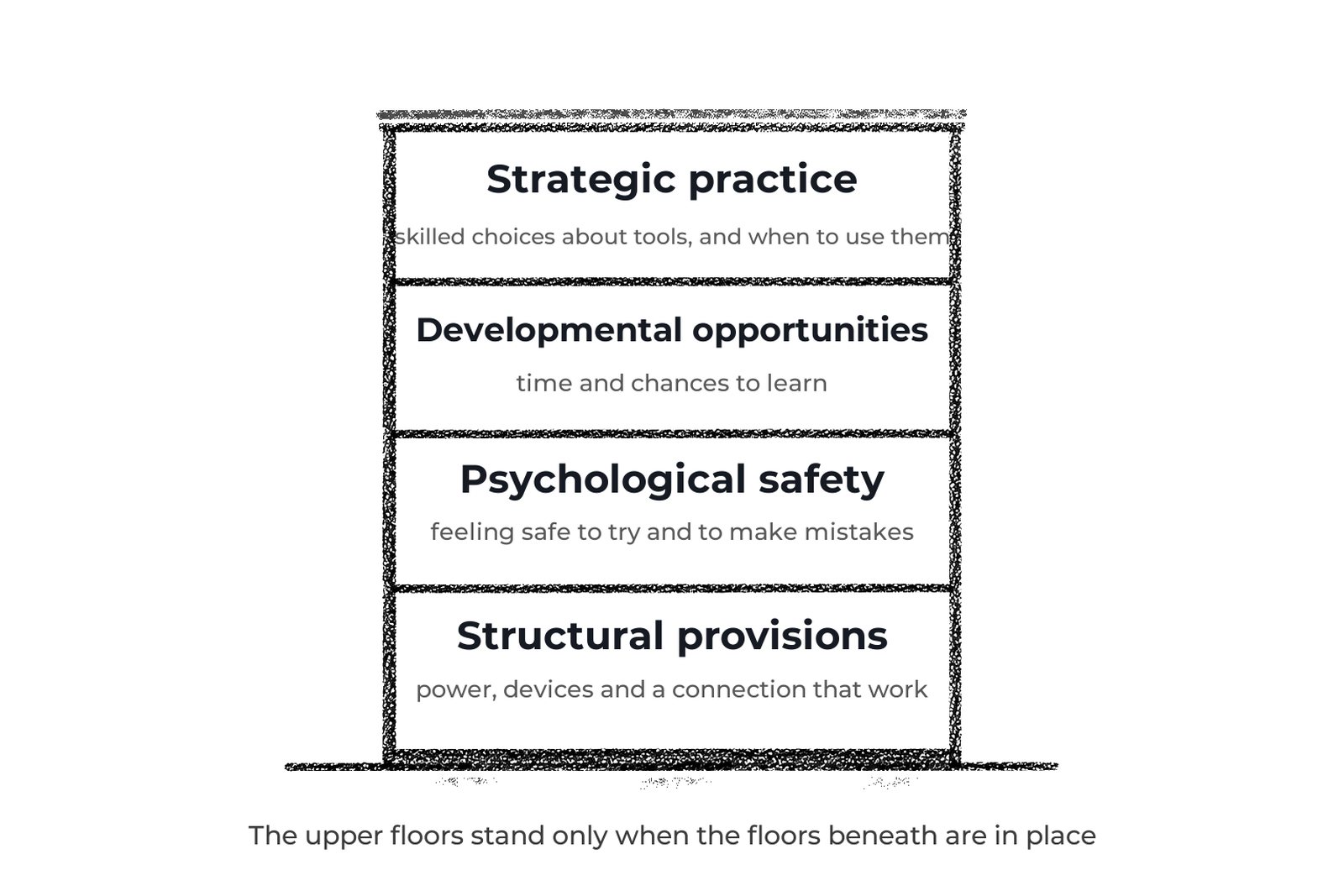
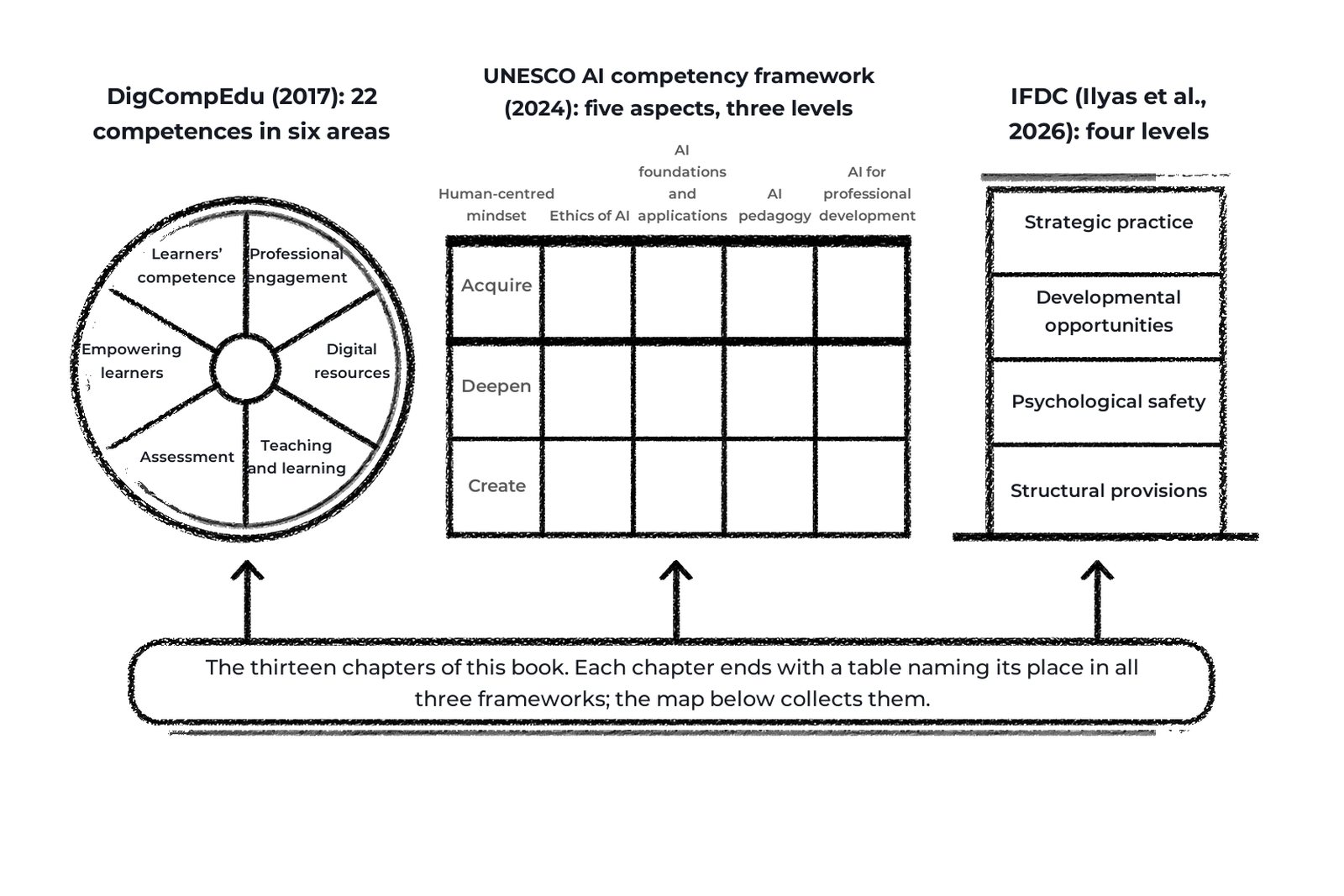
The Infrastructure-First Digital Competence (IFDC) framework came out of the author’s PhD research and runs through the book. It has four floors, and the upper floors stand only when the floors beneath are in place (Figure 1.1).
Can I copy the worksheets for my class?
Yes. The worksheets PDF (Appendix C, with seven worksheets and twelve lesson cards) states: “These pages may be copied for use in your own school.”
How do I cite Teaching in the AI Era?
APA 7: Ilyas, M. T. (2026). Teaching in the AI era. https://doi.org/10.5281/zenodo.24085773. In-text: (Ilyas, 2026) or (Ilyas, 2026, p. 112). BibTeX is in the citation box.
Who wrote Teaching in the AI Era?
Muhammad Tayyab Ilyas taught science and mathematics in a government elementary school in Gujranwala, then spent five years as the district’s assistant education officer and teacher trainer. He holds a PhD in Education from the Universitat Autònoma de Barcelona, has published on teachers’ digital competence and AI, and is the founder of PakEdX, an AI platform for teachers in Pakistan.